
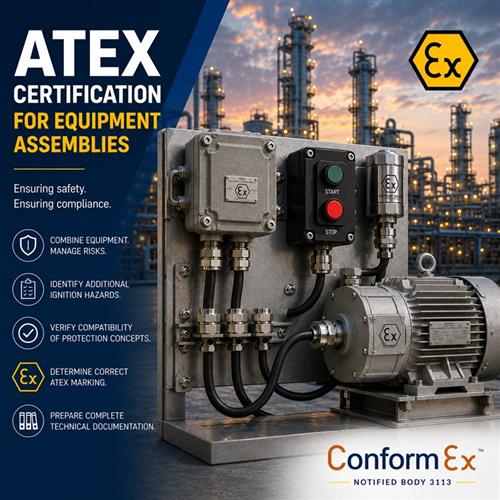
ATEX certification for explosion-proof equipment assemblies
The importance and challenges of achieving compliance for explosion-proof equipment assemblies
Explosion-proof equipment assemblies have a significant share in the explosion-proof products market and are challenging for assemblers due to the following reasons:
1- The variety of explosion protections available in the sub-assembly equipments;
2- The possibility of the sub-assembly equipment being located in different hazard zones at the installation and operation site of the assembly;
3- Determining the ATEX marking of the assembly in terms of its structure difference from the typical structure of the marking of explosion-proof equipment;
4- Collecting certificates and D.o.Cs for the equipment used in the assembly, given that the equipment, components and protective systems assembled in an assembly must all have a valid ATEX or IECEx certificate;
5- Collecting the technical file of the sub-assembly equipment in full, given that the equipment is manufactured by different manufacturers and in some cases the sub-assembly equipment are purchased from intermediary sellers;
6- Identifying and eliminating possible ignition situations (risks) in the assembly that may arise after the sub-assembly equipment is assembled.
What information do you need to provide to notified body and which are the steps involved in the evaluation of an an equipment assembly?
1- Prepare a list of the equipment and components included in the assembly.
download the list format here.
-
for completion needed information in the column "the expected hazardous zone where the item will operate", consider the following points:
-
if the whole assembly operates in a same hazardous zone, indicate the same zone in all lines of this column.
-
if the different items (devices) within the assembly operate in different hazardous zones, indicate the zone which is relevant to each item separately.
-
-
for completion needed information in the column "method of item approval within the assembly", consider the folloiwng points:
-
if the device included in the assembly is intended to operate in zones 0 and 1 for gas atmospheres and zones 20 and 21 for dust atmospheres, the approval of it, is done by presenting ATEX and/or IECEx certificates.
-
if the device included in the assembly is intended to operate in zone 2 for gas atmospheres and zone 22 for dust atmospheres, the approval of it, is done by presenting ATEX declaration of conformity (DoC) which has been provided by the manufacturer.
-
Note: a copy of ATEX and/or IECEx certificate, for each equipment and component within the assembly, as well as declarations of conformity (DoCs) only for those which are intended to be operated in zone 2 for gas atmospheres and zone 22 for dust atmospheres, should be received from the relevant supplier/manufacturer and to be presented attached to the above-mentioned list.
2- define ATEX marking for assembly
Case 1: The assembly as a whole is intended for use in
-
one potentially explosive atmosphere
of
-
one specific zone.
Where the individual parts of the assembly are marked for potentially explosive atmospheres having different characteristics, the part with the lowest level of safety, defines the marking of the whole assembly.
it means that the folloiwng charachters with the lowest requirement for the equipment, has to be used for the marking of the whole assembly.
-
category,
-
temperature class, and
-
explosion group.
Examples of marking for the case 1 assemblies:
-
An assembly consisting of parts marked with T3 and other parts with T6 shall be marked T3 to indicate, that it is, as a whole, intended for use in T3 atmospheres.
-
A pump unit consisting of a liquid pump (non-flammable liquid) and driving electric motor. The pump is marked II 2 G T6, the motor II 2 G IIB T4. The whole assembly shall be marked II 2 G IIB T4, as the motor is the part that meets the lower requirements.
-
A similar pump unit with a pump conveying hot liquid (non-flammable). The pump is marked II 2 G T3, the motor II 2 G IIB T4. In this case the assembly shall be marked II 2 G IIB T3.
Case 2: Parts of the assembly are intended for use in potentially explosive atmospheres having
-
different physical characteristics and/or
-
different zones
If it is essential for that intended use, the marking of the assembly shall contain below charachteristics, necessary for the intended atmospheres
-
all groups,
-
categories and
-
additional markings (temperature class, etc.)
In this case, the instructions for use, installation etc. will indicate the different atmospheres/zones intended (and/or provided by constructional measures) in or around different parts of the equipment.
What does "different physical characteristics" mean?
physical nature of the explosive atmosphere, i.e different parts of the assembly may be exposed to atmospheres with different:
-
Physical states of the combustible substance,
-
Explosion behaviour,
-
Ignition characteristics,
-
Hazard mechanisms.
example 1: powder-handling system - Gas Atmosphere vs Dust Atmosphere
Part A - External motor and instrumentation (II 2 G) installed in a flammable gas/vapour atmosphere.
Part B - Dust collector or cyclone (II 1D) installed in a combustible dust atmosphere.
example 2: Solvent storage - tank Interior vs External Area
Inside the tank, there is Flammable hydrocarbon vapours.
Outside the tank, there is Combustible dust generated by the process.
example 3: Hybrid Atmospheres, in pharmaceutical and chemical plants, it is common to encounter:
-
Combustible dust inside equipment,
-
Flammable solvent vapours in adjacent areas.
e.g.: Inside reactor, there is aluminium dust atmosphere, and Vapour space includes flammable solvent vapours.
example 4: Different Gas Properties
situations where one part of the assembly is exposed to Hydrogen (IIC), while another part is exposed to Propane (IIA), because ignition energy, MESG, flame propagation behaviour and explosion severity differ significantly.
Examples of marking for the case 2 assemblies:
-
A fan conveying an occasional IIA T3 explosive atmosphere (zone 1) in normal operation, the fan fitted with an electric motor and some control devices placed in a zone 2, the fan accordingly marked II 2/3 G IIA T3. The motor is marked II 3 G T3, the intrinsically safe control device II 2 G IIC T6. As the intrinsically safe control device is placed in the same atmosphere as the motor, the part meeting the lower requirements (in this case the motor) is the decisive item. Accordingly the marking of the whole assembly is II 2/3 G IIA T3.
-
A similar fan assembly, but with the motor placed outside the hazardous area. The marking of the whole assembly is II 2/3/- G IIA T3.
-
an assembly consists of, a junction box marked II 2G Ex eb IIC T4 Gb and a dust collector marked II 2D Ex tb IIIC T135°C Db, the complete marking of the assembly would be II 2GD or in some cases II (2) GD, depending on the system configuration and whether all components are located within hazardous areas.
3- technical documentation for the devices within the assembly
-
Prepare a comprehensive technical drawing of the assembly including all equipment and components assembled in the assembly, along with a clear status of all connections, distances, and other important technical parameters required for an assembly.
Note: If some items (equipment or component) in the assembly are located in different hazardous areas (zones) or even located in safe area, this must be specified in the assemblie's technical drawing.
-
Provide data sheets of all used components and equipment within the assembly
4- risk assessment of fulfilment the limitations of the devices within assembly
download the checklist from here.
Collect the limitations, warnings and considerations which are created after assembly, from the following sources and consider them in the risk assessment report.
-
the "schedule of Limitations" section, contained in the ATEX and/or IECEx certificate for the components within the assembly;
-
the "specific conditions of use" section, contained in the ATEX and/or IECEx certificate for the equipment within the assembly; and
-
any restrictions, cautions or warnings mentioned in the installation and operating instructions of components and equipment that may be relevant to their assembly within the system.
5- ignition hazard assessment (IHA)
download the assessment report from here.
all potential ignition sources raise from the assembly, should be identified and analyzed.
Clause 6-4 of IEC TS 60079-46: the ignition hazard assessment (IHA) report should include all ignition hazards that might have been caused by the combination of the equipment in the assembly and should be done in accordance with ISO 80079-36 for both risks
-
non-electrical and
-
electrical ones.
there are some samples for potential ignition sources in the annex C of EN ISO 80079-36:2016.
in addition, based on clause 5.1 of IEC TS 60079-46, the "potential ignition sources" mentioned in the parts of IEC 60079-14 relevant to selection, installation and inspection of the electrical equipment in the assembly, should be considered in IHA and analysed.
6- inspection and testing by manufacturer
following results of ignition hazard assesmsnet, inspection and test of the assembly should be carried out as follows:
-
for the electrical aspects of the assembly, in accordance with applicable tests and inspections required by IEC 60079-14; and
-
for non-electrical aspects of the assembly, in accordance of determined relevant actions in the ignition hazard assessment (IHA) report.