
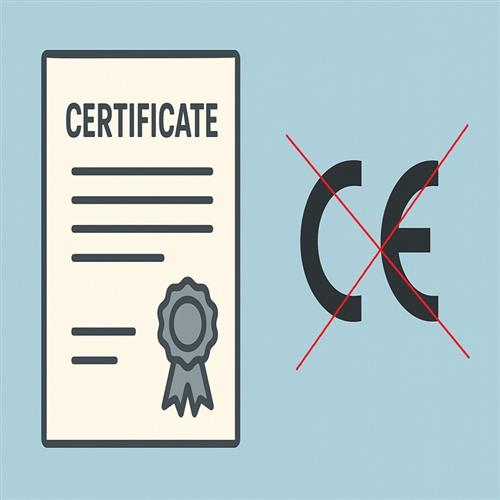
EU commission disclaimer on unregulated CE certificates


EU commission disclaimer on unregulated CE certificates

Adaptation for EU commission disclaimer on unregulated CE certificates

Publisher

European Commission - DG for Internal Market, Industry, Entrepreneurship and SMEs - Construction, Machinery and Market Surveillance - Unit H4 Market surveillance


Purpose of adaptation

clarifying that the CE mark should NOT be on any conformity assessment certificate, because the manufacturer is responsible to affixing the CE mark to the product when it complies with all the legislation applicable to that product.


Subject of adaptation

  • use of CE mark on "notified and valid CE and ATEX certificates" which are issued by EU notified bodies, has been eliminated from description of conditions and limitations for "issuance voluntary or unregulated certificates".

  • bearing CE mark for voluntary certificates.


Date of announcement: 17th Nov 2025


Description of the main disclaimer on unregulated CE certificates including the adapted points (strikethrough with red color)

Warning about unregulated certificates

Unregulated certificates, which are often called ‘voluntary certificates’ besides other names, are often issued for some products covered by EU harmonisation legislation by certification bodies not acting in their capacity as notified bodies under EU law. These practices are misleading, since only notified bodies may issue certificates of compliance for harmonised products and only in the area for which they are notified. For example, if a body is notified for issuing certificates for machinery, it should not issue certificates (voluntary or other) for non-machinery products (such as personal protective equipment – masks).

Please note that, under EU law, voluntary or other additional certificates are not a recognised means to prove compliance. Consequently, they have no value in case of checks by market surveillance authorities or customs. However, an exception arises in instances where voluntary certification is outlined in specific legislation. In such cases, while the certificate is not obligatory, it must adhere to explicit requirements if chosen to be acquired.

Voluntary certificates can create the impression that the product conforms with applicable EU harmonisation legislation, although such certificates are not issued by an authorised body.

Voluntary certificates must not be confused with third party conformity assessment certification by notified bodies within the area for of competence for which they are notified, due to the use of terms such as ‘certification’ or ‘independent third party’ or the presence of the CE marking on the certificate.

CE marking can only be affixed after testing the product and performing the conformity assessment procedure prescribed by the applicable EU harmonisation legislation. It is not acceptable for voluntary certificates to bear a CE marking.


References of adaptation

1. article 30 of the EU Regulation 765/2008

2. Question 41.13 (Use of CE mark) in FAQs on the European accreditation (EA) website on March 2021;

Brief answer:

  • It is confirmed that the CE mark should only be used by the manufacturer and only on the products to which it pertains. This means that:

  • The CE mark should not be used on the certificates issued by the CABs;

  • When instances are found that CABs do not comply with the above, NABs shall ensure that compliance to Article 30 is restored, e.g. by raising a nonconformity for this issue.

  • The national accreditation bodies attention is requested for this matter.


Practical conclusion

  • what is the CE marking?

    • not an advertising Logo;

    • not a certification mark;

    • is a symbol for declaration of product compliance.

  • where CE mark can be placed?

    • on product itself,

    • product label; and

    • packaging of product.

  • where CE mark can not be placed?

    • on product certificate, because: 

      • it violates the article 30 of the EU Regulation 765/2008;

      • it causes raising non-conformity against the requirement of clause 4.1.3.1 of ISI/IEC 17065

      • it causes the interested parties relevant to the product to be mislead.

    • on DOC of product

    • on product test or conformity assessment reports

    • on product marketing material

  • who is responsible to affix on product?

    • only manufacturer (not the notified body)

  • who is responsible to make CE mark together with NB number?

    • only manufacturer (not the notified body)


whatsapp