
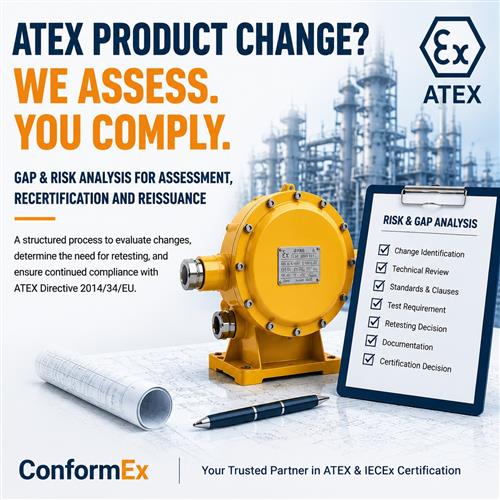
ATEX product change assessment, gap and risk analysis
Making technical changes to previously certified explosion-proof equipment has always faced challenges, the most important of which are:
-
Clearly indicate changes in drawings and other technical documents;
-
Correctly categorize changes so that the producer can correctly identify whether the change is minor or major;
-
The possibility of deviation from compliance with the standard requirements after the change is implemented;
-
Disagreement between the manufacturer and the certification body regarding the need to repeat part of the type tests after implementing change;
-
Time to conduct the assessment and cost of modification or reissuing the ATEX certificate following the changes.
By conducting a gap or risk analysis in accordance with the steps below, a framework is provided for the manufacturer and the notified body (ConformEx) to proceed with the ATEX certification assessment and modification process in an effective and transparent manner to prevent the above-mentioned challenges from arising.
Download the Gap/risk analysis for assessment and certifying product change (variation) form and use it to monitor the steps for recording and evaluating changes.
-
the columns 1 to 7 of the table should be completed by producer;
-
the columns 8 to 15 of the table will be completed by notified body and are for awareness of the producer.
1. Description of the Change
The manufacturer defines what has been changed in the product, such as:
-
mechanical or structural modifications
-
electrical parameter changes
-
material or component replacement
-
dimensional or design updates
2. Identification of Affected Parameters
Each change is linked to safety-relevant parameters such as enclosure design, temperature class, or protection concept (Ex d, Ex e, Ex t, etc.).
3. Before vs After Comparison
A structured comparison between the original certified design and the modified design is performed to identify the safety impact of the change.
4. Standards Assessment
the applicable standards and relevant requirements (clauses) to the changes, are spcified.
5,6. Technical Documentation Review
the drawings material specifications and other technical documents which have been modified following the change should be specified and highlighted.
7. Summary of Changes
a breif description for the applied changes in technical documents (e.g. drawings) such as dimensions, material type or grade and so on, is mentioned.
8. Technical Review by ConformEx
The Notified Body evaluates whether the modified documents fulfills the requirements of applicable standards.
9,10. Review of Existing Test Reports
Existing type test reports which have been already provided by external test lab, are checked to confirm whether previous results remain valid for the modified design.
11. Re-Testing Decision
A decision is made whether:
-
no re-testing is required
-
additional testing is required